Employees & Society
Human Rights
The Company has adhered to the principles of the UN Global Compact (UNGC) and aligned with the spirit and principles of international conventions, including the Universal Declaration of Human Rights (UDHR), the ILO Declaration of Fundamental Principles and Rights at Work, and the UN Guiding Principles on Business and Human Rights, to establish its Human Rights Policy.
The Company strictly complies with local labor laws and supports the core principles of the UDHR, the UN Global Compact, and the ILO Tripartite Declaration of Principles concerning Multinational Enterprises and Social Policy, ensuring that daily operations and all business activities are conducted in accordance with applicable regulations. The Company takes a proactive approach to human rights issues, incorporating them into all aspects of its operations, covering employees, customers, suppliers, and other business partners.
In 2025, the Company continued to promote human rights awareness in weekly meetings to safeguard fundamental labor rights. In the event of significant changes, procedures are handled in accordance with the Taipei Labor Standards Act through labor-management consultation. Furthermore, to promote gender equality and prevent workplace bullying, the Company has established the Sexual Harassment Prevention, Complaint, and Disciplinary Measures, issued a Written Statement Prohibiting Workplace Violence, and provides accessible grievance channels. The Company also undergoes SMETA audits, continuously improving its corporate social responsibility system to effectively protect employee rights. No human rights-related complaints were received in 2025.
The Company places particular emphasis on the following issues and concrete actions:
| Human Rights Protection | |
Actions Taken |
|
Assessment Mechanism |
|
Goals |
Short-term Goals:
Medium- to Long-term Goals:
|
Performance Results |
|
Stakeholder Engagement |
|
| Human Rights Issues | Specific Management Measures and Practices | 2025 Implementation Results |
| Eliminating Unlawful Discrimination and Ensuring Equal Employment Opportunities | The Company has established the Anti-Discrimination Management Procedure, which prohibits discrimination in hiring or employment practices based on race, skin color, age, gender, sexual orientation, gender identity and expression, ethnicity or nationality, disability, pregnancy, religion, political affiliation, membership in organizations, protected veteran status, protected genetic information, or marital status, including in areas such as wages, promotions, rewards, and training opportunities. | No discrimination incidents occurred in 2025. Hired 2 employees with disabilities. |
| Prohibition of Forced Labor | All work performed by Company employees is voluntary. No one is allowed to prohibit or force labor, exploit, enslave, or traffic individuals. Working hours comply with the maximum limits under the Labor Standards Act. Total working hours per week, including overtime, do not exceed 60 hours, with at least one day off every seven days. All overtime is voluntary; the Company does not force employees to work overtime. |
1. Ensure compliance with labor hour regulations. 2. No cases of forced or compulsory labor occurred in 2025. |
| Prohibition of Child Labor | The Company has established the Child and Underage Worker Management Regulations, prohibiting the employment of individuals under the age of 16. | No child labor was employed in 2025. |
| Employee Physical and Mental Health and Work-Life Balance | The Company provides on-site medical services, annual health check-ups, year-end parties, employee trips, and various recreational competitions, caring for employee health and fostering team cohesion. | Taiwan Operations: Organized 3 recreational activities, with a total participation of 444 employees; conducted annual health check-ups for 115 employees; provided 52 on-site medical services with 148 participants in health education. Yangzhou Operations: Organized 8 recreational activities and competitions, with a total participation of 2,100 employees; 229 employees received general health check-ups, and 264 participated in occupational health check-ups. The Company continues to strengthen employee health care measures. |
Human Rights Risk Identification and Assessment
Arizon RFID places great importance on the safety, health, and dignity of all employees. The Company complies with relevant labor laws and international human rights conventions, including the Labor Standards Act, the Occupational Safety and Health Act, and the Gender Equality in Employment Act, among other legal requirements. The Company regularly conducts human rights due diligence to identify and assess risks related to human rights issues. The process is as follows:
| 1. Identification and Assessment | Identify and assess actual and potential human rights impacts. |
| 2. Taking Action | Implement appropriate measures based on the results of the identification and assessment. |
| 3. Review of Effectiveness | Monitor the effectiveness of the measures to ensure they adequately address potential negative human rights impacts. |
| 4. External Communication | Disclose how the Company responds to relevant impacts. |
Human Rights Due Diligence
Arizon RFID adheres to local labor laws and supports the core principles of international conventions, including the Universal Declaration of Human Rights, the UN Global Compact, and the ILO Tripartite Declaration of Principles Concerning Multinational Enterprises and Social Policy. Following the guidance of these principles, the Company has established its human rights policy to ensure that all relevant personnel are treated fairly and with dignity. The Company is committed to respecting human rights policies in the recruitment, management, and development of employees.
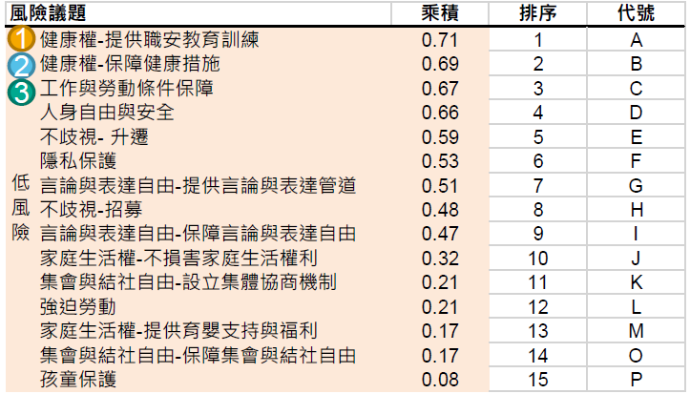
Arizon RFID refers to international human rights conventions, relevant guidelines, and human rights due diligence reports issued by benchmark companies to consolidate human rights risk issues. The Company then evaluates potential human rights risks along the value chain and incorporates them into the human rights risk assessment process. In the current year, an internal human rights risk assessment was conducted among employees through online and paper-based questionnaires.
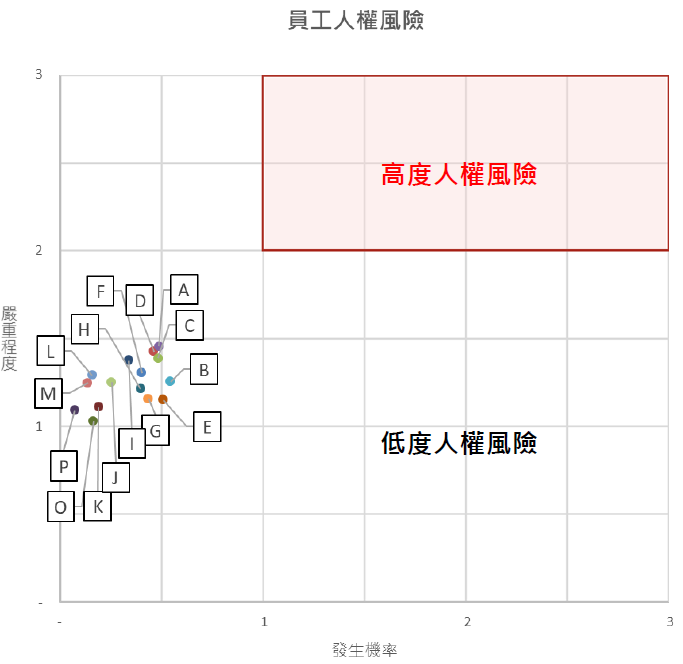
The questionnaire evaluates each human rights risk issue based on “likelihood of occurrence” and “severity”. Likelihood is scored as: 0 = will not occur, 1 = low likelihood (1%–30%), 2 = moderate likelihood (31%–60%), 3 = high likelihood (over 61%). Severity is scored as: 0 = no impact, 1 = minor, 2 = serious, 3 = very serious. Based on the survey responses, a human rights risk matrix was generated. The human rights risks were categorized into three levels according to the following criteria:
- High Risk: Likelihood > 1 and Severity ≥ 2
- Medium Risk: Likelihood > 1 and Severity < 2
- Low Risk: Likelihood ≤ 1
A total of 758 questionnaires were collected, including 147 from the Taipei site and 611 from the Yangzhou site.
According to the 2025 internal human rights due diligence results, no medium or high-risk human rights issues were identified. Arizon RFID will continue to monitor potential human rights risks in 2026, strengthen preventive and mitigation measures, and ensure the effectiveness of existing human rights mechanisms. The human rights risk assessment process will be periodically reviewed and updated based on changes in operational conditions and actual needs to continuously enhance human rights management practices.
Human Rights Training
To enhance employees’ awareness of compliance in their daily operations, Arizon RFID annually reviews and updates relevant policies and conducts refresher training to ensure employees follow legal and ethical principles, safeguard company assets, protect corporate interests, and maintain the company’s reputation. These measures also help prevent violations and support sustainable business operations. In addition, the Company organizes and participates in internal and external human rights-related training programs.
In 2025, the Yangzhou site conducted human rights protection training for employees. The total training hours reached 36 hours, with 36 employee participants. Through these training sessions, employees gained a deeper understanding of workplace ethical standards and social responsibilities, which contributed to improving the work environment, enhancing employee quality, and supporting the company’s long-term development.
Policy Implementation (2025)
The Company conducts annual assessments on human rights and workplace diversity to review labor conditions and fairness of treatment across different employee groups. The 2025 assessment results indicated no medium or high-risk human rights issues, demonstrating the effectiveness of current management measures.
Considering the workforce size and operational maturity of each site, the Company disclosed the following 2025 implementation status for major operational locations:
- Taiwan site: Female employees accounted for approximately 56% of the total workforce, with women holding over 50% of management positions. The workforce spans multiple generations, with employees aged 30–50 forming the core manpower. The Company regularly reviews gender pay differences; in 2025, the average gender pay gap was approximately 5.96%, and the median gap was about 2.78%. The Company also continues to employ persons with disabilities in compliance with regulations, ensuring workplace equality.
- Yangzhou site: Female employees accounted for approximately 45% of the workforce, with a certain proportion in junior and middle management positions. The workforce mainly comprises employees aged 30–50, showing a stable and multi-generational workforce structure. The Company continuously monitors gender pay differences at the Yangzhou site as a basis for management and improvement.
Vietnam, USA (Houston), and Japan sites: These sites are in the early stages of establishment or workforce expansion. At this stage, the Company focuses on policy implementation, and quantitative disclosure will be gradually incorporated as the workforce stabilizes.
2025 Internal and External Stakeholder Whistleblowing Channels
The channels for filing complaints are as follows:
Human Resources Department: +(886) 2 2269-0700 ext. 632
Taipei site complaint channel: tw-hr@arizonrfid.com
Yangzhou site complaint channel: Company suggestion box