Sustainable Governance
ESG Organization
Guiding Principles
The Board of Directors of ARIZON fully supports the promotion of sustainable development. In July 2022, the Board approved three key codes: the Sustainability and Social Responsibility Code, the Corporate Governance Code, and the Code of Integrity and Business Conduct. These codes establish ARIZON’s guiding principles on integrity, governance, environmental stewardship, and social responsibility, serving as a framework for both internal and external communication and compliance.
Governance Structure for Promoting Sustainable Development
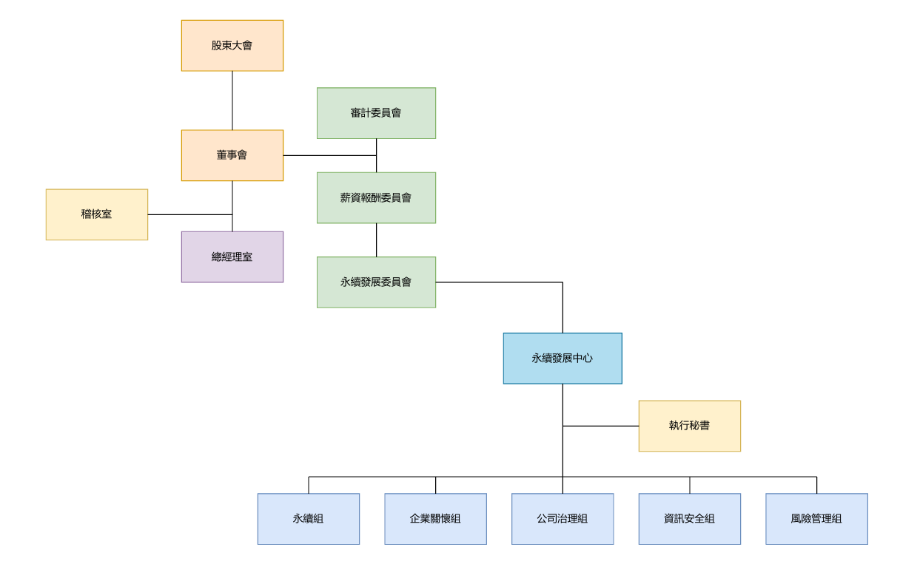
The company’s sustainable development initiatives are overseen by the Board of Directors, which serves as the highest decision-making and supervisory body. The Board is responsible for reviewing and approving the company’s sustainability strategies, sustainability reporting information, and other key proposals related to environmental, social, and economic matters.
The Sustainability Committee functions as a board-level specialized committee, tasked with supervising the company’s sustainability planning and the implementation of related objectives. The Sustainability Center is primarily responsible for coordinating all sustainability management activities, including identifying material sustainability issues, formulating management policies, and setting short-, medium-, and long-term targets along with concrete action plans. It also strengthens the Board’s oversight of ESG performance to build and maintain stakeholder trust.
Furthermore, the Sustainability Center is responsible for integrating international sustainability standards, enhancing the transparency and systematic management of ESG indicators, and coordinating external disclosure of sustainability performance while promoting stakeholder engagement. This ensures that the company’s sustainability initiatives are fully understood and responsive to societal expectations.
Under the Sustainability Center, various teams are responsible for identifying sustainability issues relevant to the company’s operations and stakeholders, developing corresponding strategies and work policies, allocating sustainability-related budgets across organizational units, planning and executing annual programs, and monitoring implementation results. This structure ensures that sustainability strategies are effectively integrated into the company’s daily operations.
The Sustainability Committee reports annually to the Board of Directors on the progress of sustainability initiatives and any key material events.
Based on these reports, the Board reviews and verifies the company’s sustainability efforts, supervises and monitors the management team’s annual execution of sustainability strategies, and evaluates the achievement of sustainability performance targets. This oversight ensures that the company has sufficient capacity and resources to respond to potential economic, environmental, and social or human rights impacts.
Sustainability Committee
To strengthen governance and enhance the effectiveness of sustainability decision-making, ARIZON established the Sustainability Committee in November 2025. The Committee elevates sustainability management to the Board level and serves as a functional committee outside of the Board’s statutory committees.
The Sustainability Committee is composed as follows:
Chairperson: Chairman of the Board
Vice Chairperson: One Board Director
Members: Three Independent Directors
Executive Secretary: Chief Financial Officer
The Committee is responsible for overseeing the company’s ESG strategies and execution across corporate governance, environmental sustainability, employee relations, responsible supply chain, social engagement, information security, and risk management. The Executive Secretary coordinates the Committee’s operations and convenes working meetings as needed, integrating resources from business units and relevant functional departments. This ensures effective management of sustainability-related risk assessments, internal controls, action plans, and target setting, aligning sustainability strategies with the company’s overall business direction.
On November 11, 2025, the Sustainability Center reported the progress of sustainability initiatives to the Board of Directors, and the Sustainability Committee was formally established on the same day. Starting the following year, the Committee will report directly to the Board on sustainability matters.
Risk Assessment Boundaries
The disclosed data and risk assessment boundaries cover the consolidated company’s sustainability performance from January to December 2025.
Risk Assessment Items and Management Strategies
The company collects various sustainability topics through internal discussions and consultation with external experts, referencing GRI Standards and key domestic and international industry trends. Systematic analyses, including department interviews and surveys, are conducted to assess the impact of each topic on management, evaluating the effects on the economy, environment, people, and the company’s operations. The assessment also considers the level of concern from key stakeholders regarding each material topic.
After consolidating and prioritizing the results, and confirming with senior management, the company identifies environmental, social, and governance (ESG) issues that are materially significant to business operations.
In addition, the company established the “Risk Management Policy and Operating Procedures” on August 16, 2022, and revised certain clauses on November 11, 2025 to align with the current organizational structure. Please refer to the company’s Major Internal Regulationsfor details.
2025 Risk Assessment Items and Management Strategies
| Material Topic | Risk Assessment Items | Risk Management Strategies |
| Governance | Customer Relationship Management | Establish multiple channels for customer communication and feedback to improve communication efficiency. Implement a complaint and product analysis system to investigate each case and take appropriate corrective actions. Conduct annual customer satisfaction surveys to understand customer needs and drive continuous improvement. |
| Supply Chain Management |
|
|
| Product Responsibility & Safety |
Strictly follow product development and mass production procedures. All products undergo DV, EV, PV, and FMP processes and pass reliability testing. Implement comprehensive inspection mechanisms from IQC, FAI, IPQC to FQC to ensure compliance with regulations and standards. Regularly review quality standards and processes, strengthen process training, monitor yield and inspection data, and continuously improve quality through internal audits and final product inspections. |
|
| Innovation & R&D |
Conduct regular intellectual property (IP) training to raise patent and IP awareness. Continuously upgrade technology, optimize RFID products, and integrate IoT features. On the production side, optimize processes and use data-driven inspections to maintain a yield rate above 99.7%. Conduct competitive patent analyses and implement incentive programs to enhance R&D competitiveness. Promote cross-department collaboration and pilot projects to accelerate technology validation, and adopt recyclable materials and low-carbon processes to enhance green competitiveness. |
|
| Information Security |
Strengthen cybersecurity defenses and equip IT and security personnel with relevant certifications. Conduct recovery drills, social engineering exercises, and weak-point intrusion scans to enhance information security resilience. |
|
| Social |
Talent Attraction & Retention, Talent Development |
|
| Occupational Safety & Health |
|
|
| Human Rights Protection |
Conduct regular employee human rights due diligence and periodically provide human rights awareness training. |
|
| Environmental |
Climate Change Response |
|